
Since long time I wanted to write a post about it. I love sea fish soups, and to be honest this is not one of my favorite Hungarian food, but mostly because it is not so easy to find restaurants that makes it really well and it is also not easy to find really nice fish in the local shops (also due to the fact that Hungarians are not really eating much fish, according to statistics the last in Europe for fish consumption, so fish shops cannot really have a great choice, being hard to sell), the best way is to know a fisherman, and that’s what I do by lake Balaton (and coming the fish from free waters and from a large lake, usually it tastes better and it never has any unpleasant mud/weeds flavor, moreover I can get it always freshly caught).
But if you can get nice fish and if you cook it right before serving it, it can be a nice dish too, it is an important recipe inside the Hungarian cuisine, and it is usually served in Christmas time.
The origin of the dish is not 100% clear, some sources place its origin in the area that nowadays belongs to Vojvodina. Some other sources report that the first similar version of it appeared on the actual Hungarian soil in a book written in Szeged at the end of the 19th century and it was called “halpaprikás halászosan“.
One curious thing: I have an old Hungarian cookbook with fish recipes dating back to 1894, there are about 200 fish recipes but no mention at all to any kind of halászlé (and just 2 other fish soups, without paprika).
Moreover, in the older books of the 20th century you can find various types of halászlé: Szegedi, Bajai, Balatoni (even more specifically I found Lellei halászlé and Füredi halászlé, even a “Fonyódi petyek”), Szigetközi, Tolnai, Kalocsai, Paksi, Mohácsi, Korhely (this is quite different), and probably some more.
Another curiosity, in the famous cookbook written by Gundel in 1934 are mentioned the halászlé of Szeged, Kalocsa and Paks, but any mention to Baja.
It is not always clear the exact differences between all of them (for example the above mentioned Gundel says that in the Szegedi halászlé 4 types of fish were used: common carp, wels catfish, zander and sterlet, but nowadays they usually do it with less types of fish in most of cases), there is often confusion between the sources, but nowadays we can say that the main difference is between the Dunai/Bajai version and the Tiszai/Szegedi version, with the last one being probably the most common in restaurants and the one which is usually served in Budapest for tourists.
The main difference between the two is that for the Szeged version there is a base stock in which parts of the fish (heads, central bones and collars, but sometimes also fish of lower value like crucian carps, breams, rudds) are being boiled and then passed through a strainer. And the Szeged version of the soup is usually served with bread, while the Dunai/Bajai halászlé is usually served with a type of pasta called “gyufateszta“.
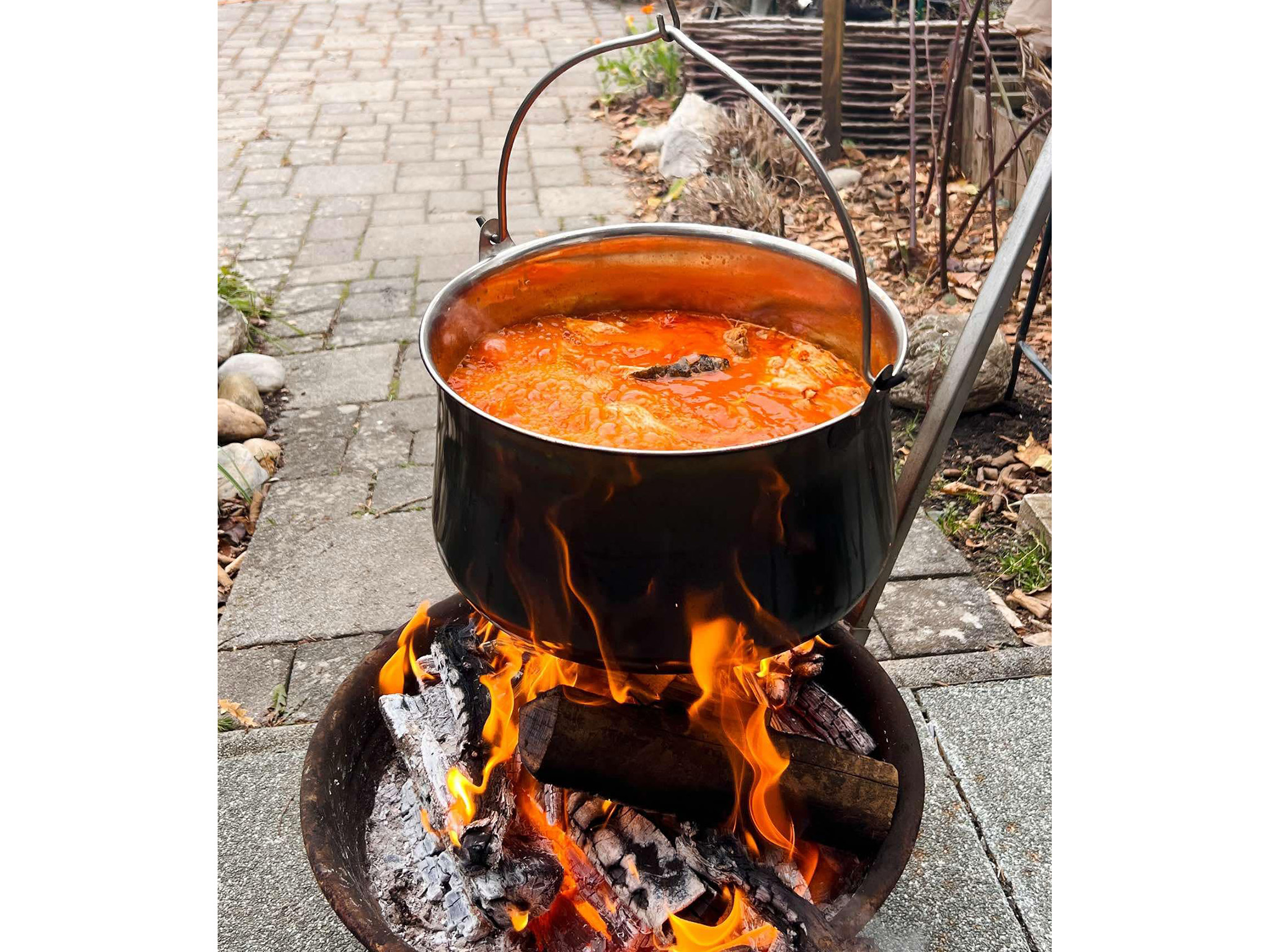
But I want to show you the version that the old fishermen very probably used to prepare, cooked in a cauldron on open fire (bogrács in Hungarian), and it’s hard to believe that they were passing the fish through a strainer while cooking in open air, so what I am going to show is about the Dunai/Bajai halászlé.
The main fish used nowadays is the common carp, but the soup gets richer if you add some other fish too and also some fish roe and milt.
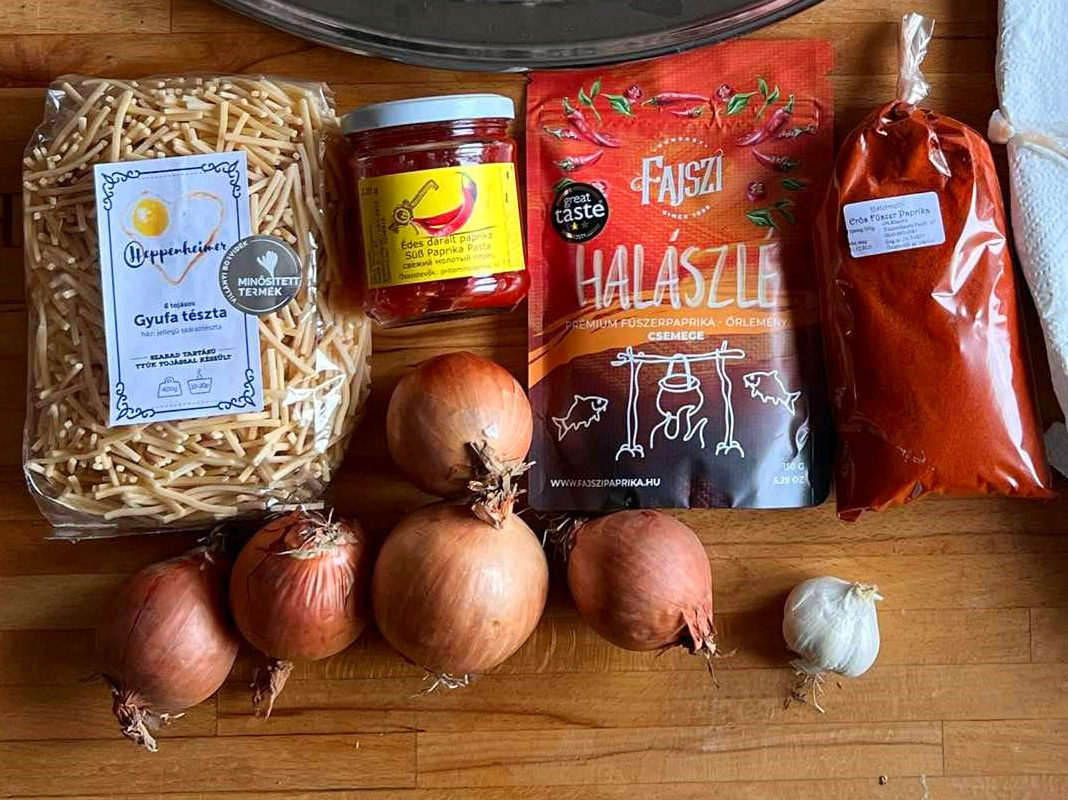
INGREDIENTS (for about 8-9 people):
- 2,7 kg common carp/mirror carp
- 1,3 kg wels catfish fillet, without skin (not the African sharptooth catfish, sadly nowadays very common on the local market)
- 500 g northern pike
- roe and milt at your taste (we used roe and milt from few northern pikes)
- 2 cloves of garlic
- 5-6 medium size onions (about 1 for each kg of fish)
- 5,4 liters of water (count about 1,2 liters for each kg of fish)
- few cascabel chili if you like (cseresznyepaprika in Hungarian)
- paprika powder (count about 1 full spoon for each 500 grams of fish, I used 8 full spoons of sweet paprika powder specifically ground for the fish soup, thinner than usual, and half spoon of spicy hot paprika powder)
- homemade/artisanal sweet pepper cream, I used 2 spoons (optional)
- salt, count 20 grams for each kg of fish
- First of all, score the cleaned carp and pike on both sides, make cuts every few millimeters to break the smaller fishbones, for the pike stay even closer with each cut, then cut them into slices of about 2 fingers thick. Cut also the wels catfish fillet into slices. Then put salt on all of them (do it about 15 minutes before cooking).
- Cut the onions small, also the garlic, and place it in a cauldron of the right size.
- Add all the water and the cascabel chili (if you use it), and all the carp, and place the cauldron on the open fire. We need strong flames all the time, so keep adding enough wood until the end.
- When the water has reached the boil (it will take probably about 15 minutes), add the remaining fish, the paprika cream if you use it, and add all the paprika powder. From this moment count about 35 minutes.
Remember, the flames must be very strong until the end, after this time the liquid will have reduced of at least 3-4 fingers and got thicker, with the paprika perfectly merged into the water and not unpleasantly just floating on it. You will notice it also by looking at the sign left on the cauldron’s side. - Don’t stir the soup with any spoon, but just move the cauldron every few minutes.
- Add the roe and the milt just in the last 8-10 minutes.
- Serve it immediately, with gyufateszta (previously boiled in water) or with bread if you prefer.
The best wine pairing in my opinion is with a traditional local grape variety called Kadarka, I suggest a fresh version of it, and I like the ones from Szekszárd region.
But this time we opted for a rare older local grape variety called csókaszőlő, it is “kind of” similar and it fits quite well too.
For gyufateszta: you can make it easily also by yourself, count 1 egg for each 100 grams of flour.

 Polenta & Baccalá