
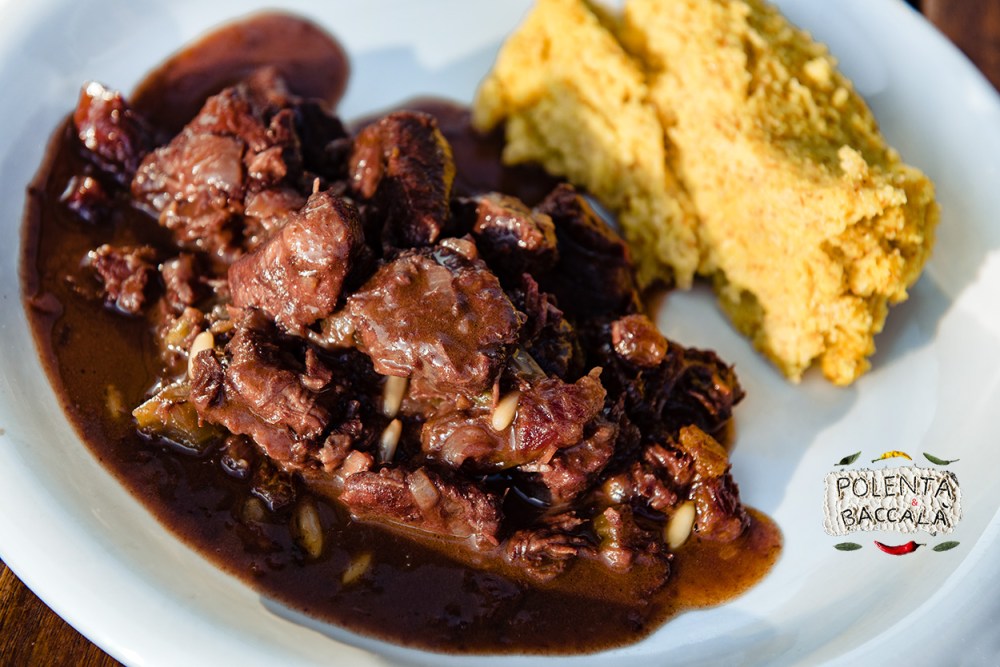
I love game meat, in winter I use to prepare it more times, and wild boar is between my favorites.
I use to prepare it stewed, with usual Italian flavors, but this recipe it’s very unique for nowadays common taste, and the first time it can be very surprising 🙂 perfect for some special occasion.
It’s an old Tuscan recipe, whose origins date back to Middle Age time first (obviously without chocolate then) and developed during the Renaissance time, when more fruits and spices have been added to it. The use of chocolate is recorded for the first time in the famous book of Pellegrino Artusi “La scienza in cucina e l’arte di mangiar bene“, written in the 1891.
Mostly only pine nuts and raisins are used, but I thought that some dried plums would fit perfectly too, and even some dates (there are some recipes from Ancient Roman times where dates where used in some wild boar recipes, so why not?).
A curiosity: in the past in Tuscany also crested porcupine used to be cooked in this way (nowadays it’s illegal) 🙂
Let’s see! (here below the ingredients for the “dolce forte” sauce)

INGREDIENTS (4 people):
- 1 kg wild boar meat
For the marinade:
- about half liter red wine
- 1 medium size onion
- 1 rib of celery
- 1 carrot
- 2 cloves
- juniper berries
- fresh rosemary
For the sauce:
- 1 big onion, 1 big carrot, 1 celery rib
- extra virgin olive oil
- 40 g dark chocolate, 70%
- 30 g sugar (or chestnut honey)
- red wine vinegar (2 fingers of a glass, about)
- 30 g pine nuts
- 30 g raisins
- 3-4 dried plums
- candied citron (if you can’t find it, some candied orange peels are fine too)
- 2-3 bay leaves
- freshly ground black pepper
- salt
- The day before put the wild boar meat (trim the fat and cut it into pieces of the same size, about 3-4 cm) in a bowl with the wine and the vegetables cut into pieces, not too small. Also the juniper berries, the cloves and the rosemary. Leave it in the fridge at least 12 hours.
- The day after take a large pan, heat a drizzle of olive oil and then add the drained meat to brown. Do it well on all the sides, until its water evaporates.
- Meanwhile take a cocotte, heat a generous amount of extra virgin olive oil and start simmering the onion, carrot and celery, cut into small pieces, until soft.
- When the vegetables are soft and the meat well browned, add the meat in the cocotte, some bay leaves, cover it with half of the marinade wine, and add also some hot water (or stock if you have). Season with some salt and pepper. The meat has to be almost covered with liquids. Cover the cocotte and let it simmer at very low heat for about 2-3 hours, depending on the animal’s age.
- When the meat is soft and falling apart easily, take a small bowl and prepare the “dolce forte” sauce: add the vinegar and the sugar, then the chocolate cut into very small pieces, mix well and then add all the fruits (raisins and plums must previously be soaked in warm water for about 1 hour, and then squeezed) and the candied cedar. (someone prefer to boil the sauce first separately, before adding it to the meat).

- Add the dolce-forte sauce to the meat , and let it simmer together for other 5-10 minutes.
- Serve it. Next to it I prepared Polenta.
 Polenta & Baccalá
A really comforting dish perfect for the chilly weather!
LikeLiked by 1 person
Exactly 🙂 thanks!
LikeLike
The porcupines! We were in Volterra some years ago and the owner of the agriturismo told us about the old custom of eating them. At first I thought he was joking but soon realized that he was serious. I can’t imagine how it is possible to rid the porcupine of all the dangerous sharp spines!
LikeLiked by 1 person
I also have no idea how to clean it, I never did 😀
LikeLike